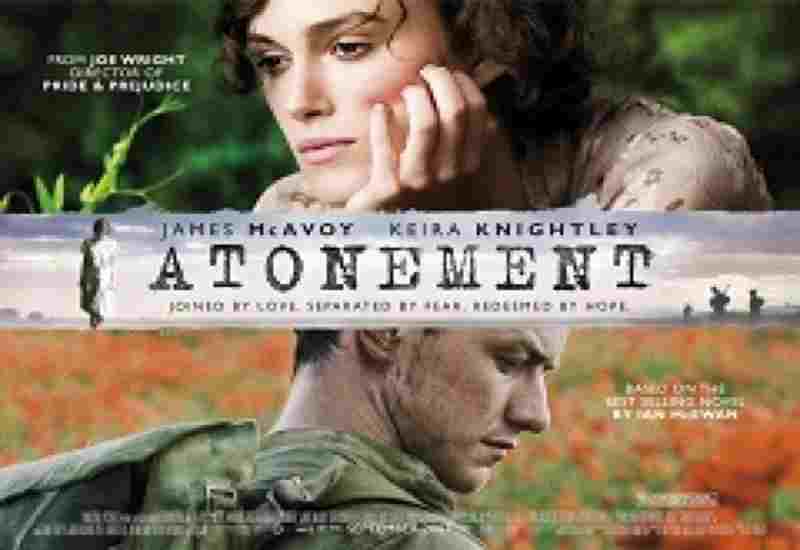
Atonement Movie Analysis
Atonement movie analysis. Adapted movie analysis by analogy with its original book. Atonement characters, Ian McEwan's Atonement. Briony, Cecilia Tallis, and Robbie Turner. Movie adaptation Jone Wright's Atonement.THE TRIALS OF ARABELLA
“THE TRUTH THAT BECOMES AS GHOSTLY AS INVENTION” by Mahir Barut

I am sure that most of you watched at least once Atonement which is adapted by Joe Wright or read the novel by Ian McEwan. In this post, we will talk about impartial psychological realism and the narrative structure embedded in the plot.
The movie starts -in tune with its original book- with the completion of “The trials of Arabella”, Briony’s first play. In the immediate opening, this play gives us a significant hint about the beliefs and attitudes of the narrator in a form of a brief critique. In this first part, our narrator is the heterodiegetic narrator, and the point of view is the 3rd. Person and Godlike omniscient narrator however this will not permanently posture throughout both movie and novel. In the same manner, the movie also keeps the same perspective without changing the point of view.
Side Reader in Atonement
As I mentioned above, The Trials of Arabella plays a key role as it opens a gate from the Auto diegetic narrator to the heterodiegetic narrator. This happens via the voice of the narrator and meanwhile, we are becoming inadvertently secondary readers or we can call it “side reader” but it is too early for any acknowledgment of this hidden frame. But this critique, at first reading, if you have not watched the movie yet may have been misinterpreted through the first part of the novel. Our heterodiegetic narrator is presumably absent from the narration but there is an obvious interference in the psychological implications of the failure in Briony’s tentative attempt to act out her first play.

Atonement Character Analysis
In the movie, this is presented to the audience by means of the voice of the typewriter in accordance with particular moments of tension. But the scene in which Robbie typed a pathetic excuse for Cecilia, with a cunning addition what Director of the movie, Joe Wright skillfully added in, disperses the focus on Briony’s writing and helps the conjuncture of the story by springing out a surprise for the audience at the last part of the movie in a way which will be congruent with the original book. It is for this reason in the movie to comprehend this fact- the connection and the gate between the two different narrator- is really hard. On the other hand in the novel, we are facing with deep insights which directly implies a strong emotional turmoil in a non-specific point that is reflected from a remote future with the sudden state of impulses to interfere with the internal feelings and motives of the characters by adding strong arguments upon realism which seems to be irrelevant to the simplicities of most scenes. For example, this paragraph cited from Part-1, chapter three is a perfect testimonial to the fact how a hidden auto diegetic narrator interferes in the narration of a heterodiegetic narrator.
Atonement Character Analysis
“ A story was direct and simple, allowing nothing come between herself and her reader – no intermediaries with their private ambitions or incompetence, no pressure of time, no limits on resources. In a story you only had to wish, you only had to write it down and you could have the world;…”
Needless to say, of course, this is not a premature confession of a regrettable mistake or a preposterous attribute because she is solely the narrator of her own world in her own book, and it is not… because she is herself also in the third part who will join to the narration and identifies herself as a narrator and writer. Thus as a natural consequence, we are also losing our narrative voice as our storyteller voice suddenly metamorphoses into a protagonist who tells the story from the first-person point of view. Therefore these interferences are not premature but are utilized to form the groundwork for a logical transition but also they have a more remarkable function in rationalization and justification of her mistakes and ignorance before making amends in front of the audiences. All these answers can be shown in the realms of possibility. Now let's turn back to Arabella’s story.Atonement Movie Analysis
In Joe Wright's movie, the scenes in relation to the play Arabella omit some vital fragments which will show the audiences the strong aspirational perspectives at the frontiers of imagination what a little girl put into action with play in which she aspires to participate as both an author and actress in an uncompromising manner. But when the book was reread after watching the movie and witnesses all climatical moments, each discriminating reading easily makes the reader got gripped on an exquisite retrospective rework on her advent of writing talents by means of The Trials of Arabella.
“ the whole thing’s a mistake. It’s the wrong… It's the wrong genre! ” ( cited part 1 chapter four)
She is sulking and Cecilia seems pretty indifferent and busy with her own affair. If she is able to externalize so emphatically there must be really something amiss with the play or writerness. And if so what may infuriate her to the point of making her a malicious, undesirable, and unwelcomed girl?