
NARRATOR VERSUS WRITER
NARRATIVE LEVELS by Mahir BARUT
Narrative capability is one of the most distinguished gift given to human beings which dwell on each individual in various levels of experience and types of discourses. Theorists put forward a large number of narratives to discuss. What makes the narrative perception so profound issue stems from it having a pivotal role in shaping our world. I will try to explain the implications of “the narrative jamming” upon the narrator and the reader which distorts the verisimilitude of the accounts of the narrator and writer running parallel. This premise will be underpinned by a narrative analysis of Ian McEwan’s “Atonement”. Jean-Paul Sartre, in his famous work “Existentialism is a Humanism” asserts that “Man makes himself” by underlining the morality that is chosen by mankind. I will adopt this view to “narrator makes his writer” He also claims that “ you are what you live” I will also call it “you are what you write”. In this regard, although these statements seem inextricably interwoven, sometimes you are not able to be what you write. But in which cases does this happen? Is this a direct consequence of the narrative jamming we experience every day consciously or unconsciously? Roland Barthes explains this natural affinity as follows;“Narratıve starts wıth the very hıstory of mankınd; there ıs not, there has never been anywhere, any people wıthout narrative; all classes, all human groups, have theır storıes and very often those storıes are enjoyed by men of dıfferent and even opposıte cultural backgrounds: narratıve remaıns largely unconcerned wıth good or bad lıterature. lıke lıfe ıtself, ıt ıs there, ınternatıonal, transhıstorıcal, transcultural.”This quotation inspired many researchers on their works as a starting point to the depths of the narrative discourse however, I will be hesitant and barely inclined to agree that it is “like life itself” as long as and only if mankind themselves narrates this premise. The reason that causes me to have serious reservations about this point is the same as the notion that led me to recognize the dual role of the narrative within the entire span of the history of mankind. The narrative is the key player in our life with its dual role as a means of communication with the present and as a device of imitation of the past which also paves the way for the prediction and creates the power of determining or constructing the future. All these come to happen through the triangular interaction which is composed of the narration, the narrator, and the reader. Thus, as the quotation suggests above, narrative can not be confined to a group of writers or some leading intellectuals of a certain elite. It encompasses the whole of society and spans nearly a complete life from the onset of childhood to adulthood for each individual. Some believe even the period of infancy can be conceived within this process. Let’s have a look at the incident In Ian McEwan’s Atonement, in which Briony Tallis’s pretense of being drowned takes place in the river is corroborative evidence to this notion. This example directly brings us to the focal point of the ongoing dispute on the reliability of the narrator by extension usually the author himself. Many questions arise at the very heart of this argument. To what extent can the narratives be versions of reality? Whose voice is it we hear of? Does the narrator narrate everything? Can the Subjective identity be reconstructed? what is the role of the narratee amid these debates? All these arguments stem from the uncertainty of the posture that the narrator adopted towards the narrated and the narratee at the exact time of narrating. Here, the narrative time interferes with the core of the problem as another indelible component. In order to grasp the argument let's remember Briony Tallis as an author who just reached the age of 77 in 1999 and finished her last novel, its origin derived from her childhood and its earliest version from January 1940. As it is clearly seen, It nearly spans a complete life. But the point is the resulting implication being that “ it will also inevitably span the whole narrative time” from the very beginning of the narration to the final sentence which will mark the end of the narration. However, we do not know precisely how long it took for Ian Mcewan to finish his novel, but by his novel Atonement, he is projecting the very epitome of this process. This instance is mapping the whole history of the narrative but in a way in which many questions arise from the time gaps between the different acts of narrating all along the different acts of writing time. Is it plausible for the narrator to remain the same person while the author is still getting older? How can an author adapt himself to the continuum mechanics in the diegesis3 of the narrator? If the narrator is not the one who writes and the writer is not the one who narrates according to the structuralists whose narration is it we read? These are absolutely absorbing questions as relatively much as controversial. These arguments scattered over the subsequent chapters with their relevant subpoints will be debated in direct references to Atonement. Roland Barthes claims that the conceptions that seem to have been formulated so far which determine the point of view are inadequate to the question “Who is the giver of the narrative?” He points out that the bulk of the problem is embedded in the codes in which the narrator’s and the reader’s presence can be detected within the narrative itself in “two different systems: personal and impersonal. He adds that although this approach may come in handy its efficacy is limited. He underlines the insufficiency of the linguistic marks hence it may be sometimes a faking practice and can mislead us in a text written in the third person, in fact, which is in the first person. He is totally right in his stance because, on many occasions, eliminating the presence of the person who is speaking apparently remains controversial in itself especially in paratextual narrations as it was in the case of Atonement. This fact will lead us to seek the answers not along the tortuous fields of narratology but absorbing. On Atonement. Ian McEwan in his work truly provides for such an attempt at an extensive field of study in narration hence it has this built-in paratextual structure. CHAPTER ONE THE LEGACY OF THE COMPLICATIONS OF NARRATİVE THEORY 1.1.NARRATIVE CONFIGURATION
“Long ago when anımals and human beıngs were the same, there were four brothers who went about doıng good. Comıng to the Squamısh Indıans one tiıe, they were persuaded by the chıef to stay a whıle ın hıs vıllage. Knowıng the wonder-workıng powers of the brothers, the chıef saıd to them, "Won't you brıng the salmon people to our shores? We are often short of food. We know that salmon ıs good, but they never come to our waters."….”There are various forms of narrative in the history of mankind. The quotation above from an American Indian legend is a testament to the ubiquity of the narrative to how it came to be known long before the theories of the narrative were brought by Russian formalists and French structuralists such as Vladimir Propp (1968), Claude Levi-Strauss (1977), Roland Barthes (1977), Gerard Genette (1985) and post-structuralists such as Umberto Eco(1979) and Jean Francois Lyotard (1979). Due largely to the extensive and influential fields of narrative in daily life, it is hard to make a definition in concrete terms for narrative. Furthermore, we need much of its definition for a deep understanding. Narration is a part of the world we all personally understand and each of us virtually rebuilds in response to what we perceive, remember, and predict. In other words, narration is a version of reality. Tales, novels, films, essays, cartoons, and stories all are written at a specific narrative level by a narrator according to different purposes. Narrative is also a human tendency and desire. This intrinsic attempt may be rooted in the curiosity of man for the unknown. Curiosity and cognitive endeavor are promoted by the linguistic intuition of each language and cultural legacies. Narratives can also be classified beyond the written and oral narratives known popularly but the core of the narrative remains unchanged whatever we integrate or subtract from the narrative we have certain principles for constructing a narrative applicable to its all forms. We can see narrative in visual gestures, and physical activities and we can read it in talks as a part of daily causal conversations, ceremonies, movies, and even in the classroom. Another form of narrative activity can be read in musical arts such as jazz, piano, classical music, folksongs, rock and roll ..etc. Pictorial arts can also be read as a form of narrative such as family photographs, diagrams, models, drawings, and oil paintings. They can be surprisingly quite effective and convenient in conveying the mystic, complicated, and historical tales as a primitive form of narrative such as the cave painting given below;

“ No doubt It has always been that way. As soon as a fact Is narrated no longer wIth a vIew to actIng dIrectly on realIty but IntransItIvely, that Is to say, fInally outsIde of any functIon other than that of the very practIce of the symbol Itself, thIs dIsconnectIon occurs, the voIce loses Its orIgIn, the author enters Into hIs own death, wrItIng begIns”Roland Barthes apparently made an assertion but was and is still being regarded as a proclamation rather than a simple assertion from the immediate publication of his essay onwards. Since then, the relationship between the author and narrator has been underestimated or hasn't been studied enough by scholars. Now let's return to the cave painting and imagine how it is constructed by its painter until the final composition and become a painter simultaneously of our own canvas. first, we draw a layout then draw an open moor and proceed with animals. We decided to make some supplementary changes and add a gloomy sky and stars. Hunters and dancing women come next and go on this way. If we figure out this process in our own accord, each of us will experience different phases of stagnation. These stagnations, willingly or compulsory, will determine what the paintbrush will cover next on our canvas. In other terms, We will have to make a nexus of the objects and feelings according to what we read in the current composition on hand. We will look at the incomplete work, we will make a choice between the possible options and we will have to provide a coherence between the thoughts we have and the course of the events what the work indicated. Most importantly in the end we will have been affected by this incomplete work by making a compromise between the world we built and the world on which we work. This seemingly means that we will have to become the narratee “reader” from the first brush applied to the end. This is the first intervention that occurs in the act of narrating and I am suggesting this momentous intervention is not being made directly by the narrator or the writer itself but being made at a higher level than the narrating and writing levels because it encompasses two points of views which are of the reader and author. We become the first reader of our work with each intervention and each time the course of the events changes from the angle of the reader-author. In this regard, neither the narrator nor the writer is the writer or the narrator in classical terms of what we recognize as the writer or the narrator until the completion of the work. This resulted in a tussle between the narrator and the writer throughout the work as follows in Ian McEwan’s Atonement.
“ But now I can no longer thInk what purpose would be served If, say, I trIed to persuade my reader, by dIrect or IndIrect means, that RobbIe Turner dIed of septIcernIa at Bray dunes on 1 June 1940, or that CecIlIa was kIlled In September of the same year by the bomb that destroyed Balham Underground stattIon” ( page 350 ) In thIs quatation, the questIon I wIll tackle Is that “We see in this paragraph the narrator reveals himself but more significantly by including the reader in it as a justification for her stance as a writer. At the moment she confides her anxiety and concern she also reveals a higher level than the narrator and writer by implying how she becomes entangled with such a sense of indecisive steps on her tortuous path. These moments can be usually seen at each beginning and each end of the work which are the moments where the intensity of the involvement is most distinguished and eloquent because of the fresh attempts and need to change the mood of the distance and focalization of the narrator by the author. Our fragment was from the end of Atonement when the narrator introduces himself surprisingly as a writer of the work to the reader with some sheer resentment to the reader and the publishers as if she is trying to shirk her responsibilities or forget her lifetime failure on belated work. She directly tends to join the reader not to the main plot of the story but in an implied manner connects the reader to the process of writing by revealing the roles and influences of the reader on herself throughout the novel and her own life. Now this time let's look at the following fragment from the beginning of Atonement;
“In a story, you only had to wIsh, you only had wrIte It down and you could have the world; In a play you had to make do WITH what was avaIlable: no horses, no vIllage streets, no seasIde. No curtaIn. It seemed so obvIous now that IT was late: a story was form a telepathy. By means of InkIng symbols onto a page, she was able to send thoughts and feelIngs from her mInd to her reader’s”As it seems, our focalizer or narrator freakily changes the distance, and the focalization shifts to a different level. Our hetero-diegetic 3rd person omniscient narrator suddenly turns into 1st person narrator but again omnisciently. The narrator directly addresses the reader and the reader finds himself as a direct addressee by a delicate sense of rhetorical substitution of the pronoun “you” which indicates both the reader and narrator. It refers to an unreal condition and the balance of the time distance is being distorted but this can not be explained by the foculization because the foculization occurs within the diegesis of the characters, not the reader and narrator although the distance can be changed within the diegesis of the narrator as it becomes in the final coda of Briony added at the end of Atonement.
“If you only had written It down you could have the world” It becomes; “If we only wrIte It down we can have the world”Now a zero condition comes up with the pragmatic signals- the narrator addresses an addressee using the second person pronoun “you” We are forced to draw an inference having face-to-face with the narrator in a strange manner we can not easily define the narrator in the sense we got used considering the previous and subsequent mood on the novel. I will later show the differences between the focalization and this case of shift. But firstly ask the question “Who is speaking to the reader? I will propose a different kind of narrator and communicative level in response to the argument and try to define their characteristics and principles. I will call this new voice “ trans or inter-narrator” and will term this specific involvement where the internarrator emerges as “the jamming” and its level “prediegetic level” One can understandably claim that the jamming appears to be some kind of autobiographical fiction. I will respond that this is not the case by reminding them how the distance and the voice of the narrator prevail at the beginning in the narrative level of autobiographies and how the narrator introduces himself to the reader is clear and eloquent. Let's remember Charles Dickens’ David Copperfield or Great Expectations and Franz Kafka’s Metamorphosis. All revelations manifest themselves in the settling of background and in the course of the unfolding plot definitely not on the narrative level. But this doesn't mean in these autobiographical fictions there is no trace of the transnarrator. Of course, there are and have to be traces of the transnarrator at the points where the jamming can be detected. However, the differences come up in the way that autobiographical analysis is concerned with the past of the author by drawing analogies between the characters, narrators, and the author’s own life. But in our case, the matter that concerns us is not the past of the author but the present existence and involvement of the author and I will debate these possible complications of the presence of an internarrator by analyzing Atonement as a model of jamming in the distance, focalization and voice of its narration. I will also apply the jamming and the transnarrator to Gerard Gennette’s three narrative levels; intradiegetic, metadiegetic, and extradiegetic. In response to Roland Bartnes’s assertion “ the death of the author” which has been held in high esteem for a long time, I suggest that it is time to reverse this mythic commonplace during the postmodernism by the indelible changing attitudes of the writers towards the authorships. The tradition what the writers try to conceal and exclude themselves from the narrative was regarded as a special talent and gift to confuse and startle the reader since the onset of the written narrative but in time after as every tradition prevails enough and completes itself according to the codes of the culture pertains to its own era, this attitude starts to leave its function to another counter attitude. The table below shows the traditional communication of the narrative instance;


“WHAT A STRANGE time thIs has been. Today, on the mornIng of my seventy-seventh bIrthday, I decided to make one last vIsIt to the ImprerIal War Museum lIbrary In Lambeth. Is suIted my peculIar state of mInd. The readIng room, house rIght up in the dome of the building, was formerly the chapel of the Royal Bethlemen HospItal – the old Bedlam. Where the unhInged once come to offer theIr prayers, scholars now gather to ressearch the collectIve insanIty of the war ”We immideately discover who speaks to us so far throughout the story as a 3rd. person heterodiegetic omniscient narrator who knows everything is in fact a delusion and not was it but only a covert form of our latent narrator. Furthermore, we also realize that we know a lot about our new narrator since the three parts what we read were just telling the story of our new narrator. The first what we need to do is to draw the frame of these three parts and the final coda. The paragraph below I cited from the Prologue of “The Name Of The Rose” by Umberto Eco and I will use its frame in order to show the complications in the frame of Atonement by comparing and applying them.
“Perhaps, to make more comprehensIble the events In whIch I found myself Involved, I should recall what was happenIng In those last years of the century, as I understood It then, lIvIng through It, and as I remember It now, complemented by other storIes I heard afterward—if my memory still proves capable of connectIng the threads of happenings so many and confused. In the early years of that century Pope Clement V had moved the apostolIc seat to AvIgnon, leavIng Rome prey to the ambItIons of the local overlords: and gradually the holy cIty of ChrIstIaniIy had been transformed Into a cIrcus, or into a brothel, rIven by the struggles among Its leaders; though called a republic, It was not one, and It was assaiIed by armed bands, subjected to violence and looting”The change is temporal considering the rest of the novel but, let us suppose this is all. We have five “I”, and one “my” which project the vocal quality of a homodiegetic first person overt narrator who has a limited capacity until the lines which start with“ In the early years…”. The rest of the paragraph is told by the third-person heterodiegetic narrator. The homodiegetic narrator who takes part in action starts to tell according to his memories something else who does not take action but narrates everything omnisciently by knowing the reasons for the actions, the correct sequences of the events, and of course as a covert narrator. But I need to remind you once more according to the whole of the prologue the narrator's level does not change but I deliberately cited from The Name of the Rose in order to show that there are also temporal diegesises independently from the primary levels. In fact, it could start with a character saying directly “Let me tell you a story” or “Okay then, tell me your story” but for a deeper understanding such a tentative and specific example will be more practical in our frame below.

“THE PLAY- for whIch Briony had desIgned the posters, programs, and tIckets, constructed the sales booth out of a foldIng screen tipped on Its sIde, and lIned the collectIon box In red crepe paper- was wrItten by her In two–day tempest of composItIon, causIng her to mIss aa breakfast and lunch. When the preparatIons were complete, she had nothIng to do but contemplate her finished draft and waIt for the appearance of her cousIns from the dIstant north”

“I lIke to thInk that Isn't weakness or evasIOn, but a fInal act of kIdness, a stand agaInst oblIvIon and despaIr, to let my lovers lIve and to unIte them at the end. I gave them happiness, but I was not so self-serving as to let them forgIVe me. Not quIte, not yet. If I had the power to conjure them at my birthday celebratIon…Robbie and Cecilia, still aliIe, stIll IN love, sIttIng sIde by sIde In the lIbrary, smIlIng at The TrIals of Arabella? It’s not ImpossIble.”Now we are getting the whole picture in order to be able to draw a complete narrative frame of Atonement. But things will be getting harder this time in comparison with our first narrative instance. Let us define what it is like.

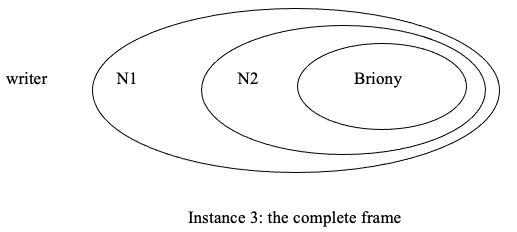


- Where is the third person heterodiegetic narrator of the first part we read in the novel throughout the first three parts according to this frame?
- Can World 2 “embedded world” be placed at an extradiegetic level above World 1? If it can be on Atonement
- whose narration did we read in the first part and in the coda?
- Is there anyone else who can be involved at an extradiegetic level?
- How can the world 2 be above the world 1?
- Can it be possible that an extra level exists above the extradiegetic level?


“In constructIng the plot and workIng It out wIth the proper dIctIon, the poet should place the scene, as far as possIble, before hIs eyes. In thIs way, seeIng everythIng wIth the utmost vIvIdness, as If he were a spectator of the action, he wIll discover what Is In keeping wIth IT, and be most unlIkely to overlook InconsIstencIs.”2.2. The Unreliability of Narrative Situations In narrative where the problem of reliability arises is on the communicative function of the text. Idealogic, historical, and political intentions of an author or a narrator including implied author within the textual product are always open to transgression when they have been read in the different mechanisms of another culture. Yacobi Tamar in his work “fictional reliability as a Communicative Problem”( 1981: 113-26.) underlines five basic principles; (1) the genetic; (2) the generic; (3) the existential; (4) the functional; (5) the perspectival. The violation of these principles inevitably brings inconsistencies and irrelevant elements to the fictive and the real composition of the text. Among these principles, the perspectival one plays the key role in Atonement. Tamar explains the perspectival principle as follows:
“the perspectival prIncIple, whICh brIngs dIvergent as well as otherwIse unrelated elements Into a pattern by attrIbutIng them, In the whole or In part, to the peculIarItIes and cIrcumstances of the observer through whom the world Is taken to be refracted”.On Atonement when we come to the coda, refractional abnormality immideately manifests itself by the question “Who read the first part to us” A narrator of the world and the narrator of the first part as an independent book seem to have overlapped with each other. By employing The Jamming frame and transnarrator we solved the problem of the communicative narrative frame. However, the problem of unreliability still exists in its author and narrator. You will remember that a matrix on each level loomed large in our jamming frame and on each matrix two binary opposites came to face to face as it has been on the picture of the narrative matrix ( see Table 3) thus, it occurs in such a formulation as follows;

“Not my best, I thought. But the whole room, except for Leon, PIerrot and myself, rose for the applause. How practIced these chIldren were, rIght down to the curtaIn call. Hand In hand, they stood In lIne abreast, takIng theIr cue from Chloe, stepped back two paces, came forward, bowed agaIn. In he uproar, no one notIced that poor PIerrot was completely overcome and put his face In hIs hands.”As it seems it is more likely as if our homodiegetic narrator seems to exceed her limited capacity and tries to turn to the heterodiegetic omniscient narrator who can access the minds, feelings, and perspectives of the other characters “No one noticed that poor Pierrot was completely overcome and put his face in his hands”. And also there is a quite distinctive retrospective act of thinking “ Not my best, I thought” which indicates a strong clash between the homodiegetic first-person overt narrator and the heterodiegetic third-person covert narrator. Especially in part one at the beginning of Atonement, a considerable amount of examples which will verify the matrixel effect and its complications on the verisimilitude of the accounts on narrative. Writer versus Narrator by each page and line and by each level and world the author tries to resurrect the phantom of what Roland Barthnes gave a ceremonial funeral in his essay. 2.3. Criticism: The Implied Author Dispute and The Transnarrator In narratology, the concept of Author-narrator first introduced by Booth (1961) closely seems to resemble our transnarrator. It is for this reason, I needed to cite a passage from “The Implied Author” written by Schmid, Wolf (Paragraph 2, the living handbook of narratology)
“The concept of ImplIed author refers to the author-Image contaIned In a work and constItuted by the stylIstIc, IdeologIcal, and aesthetIc propertIes for whIch IndexIcal sIgns can be found In the text. Thus, the ImplIed author has an objectIve and a subjectIve side: It Is grounded In the Indexes of the text, but these Indexes are perceIved and evaluated differently by each IndIvIdual reader. We have the ImplIed author In mInd when we say that each and every cultural product contains an Image of Its maker. The ImplIed author Is therefore not a category specIfIc to verbal narratIon; IT IS however, most often discussed In relatIon to lInguIstIc texts, partIcularly In narratologIcal contexts.”In Wolf Schmid’s definition of the implied author, two characteristics are underlined; the first is the author-image constituted by the indexical signs and the second is that the implied author is perceived and evaluated differently by each individual reader. This definition is usually known as a reader-created concept. In this regard, (1) the transnarrator differs distinctively from the implied author because, first of all, the transnarrator comes into view as a compensatory actor and a stabilizer in direct relation to the parameters of narrative diegesis. It is an element that recovers and restores the abnormalities of the text. (2) The transnarrator can not be perceived differently by each reader since its presence is only seen and detected on the structural frame of the narrative. It has no direct pragmatic and intentional function. It is constituted by default from the paradoxical clash between the author and the narrator by the contribution of the extra-embedded fictive worlds However, in terms of efficacy on the problem of reliability, the implied author and the transnarrator are common to each other but, they diverge from each other in which they originated. The implied author leads to the unreliability through the messages encoded which implies the author’s ideology and concentration against the different ideologies. But the reason behind the transnarrator leads to the unreliability lies on the balance of power between the author and narrator on a textual level. CONCLUSION In this study, I have tried to illuminate how the possible incongruities and some inconsistent parameters emerge in the narrative approaches that are applied to the narrative analysis in direct reference to the text of Atonement. In narrative respect, I have opened three points to debate; the first is the significance of the narrative understanding in our daily life, the second is the narrating jamming and the transnarrator, and the third is the matrix ( and matrical effect) and the unreliability as a ramification of the matrix. In my first argument, I hope that narrating understanding will provide a stimulus step to narrative analysis. The second argument I worked on put forward a proposal to revise the communicative and the textual level. Some new terms are examined in the field of narrative terminology and their practical applicability is analyzed. These are (1) The Jamming is employed to mean the occurrence of intertexual abnormality. (2) The Transnarrator where the jamming is found, is employed as a device to symbolize the textual self-reaction against the abnormality as an equalizer. (3) The prediegetic level is utilized as a necessity for the transnarrator locating in it. Finally, the problem of reliability is transferred to the analytical fields of narrative. I tried to prove that the reason for the unreliability is not only the author’s ideological traces left behind the text but also the natural result of the matrical effect which can be drawn and analyzed. I have not touched on the ethics of authorships although the unreliability and the ethics of authorships have much in common, I wanted the scope of the work to be confined to the narrative analyses. References
- Aristotle (1969), “Poetics” translated by Ingram Bywater Oxford at the Clarendon press
- H.Porter Abbot (2008), “The Cambridge Introduction to Narrative”, second edition Cambridge University Press) pp 01-24, 67-79
- Roland Barthes (1968), “The Death of The Author”
- Roland Barthes (1975), “An Introduction to the Structural Analysis of Narrative” ( The Johns Hopkins University Press pp 237-272
- Donald Braid (1996), “Personal Narrative and Experiential Meaning” (The Journal of American Folklore) pp5-30
- L.B. Cebik (1986), “Understanding Narrative Theory” ( History and Theory, Vol,25)pp. 58-51
- Umberto Eco (1990), “The Name of The Rose” ( Warner books edition)
- Gerard Genette (1972) “Narrative Discourse” (Cornell University Press) pp 212-263
- Ian McEvan (2002) , “Atonement” (NAN A. TALESE)
- Oddee, (2008) Prehistoric Cave Paintings (published under Amazing Art)
- Schmid, Wolf (2010), “The living handbook of narratology”: "Implied Author", Paragraph 2. In: Hühn, Peter et al. (eds.): Hamburg: Hamburg University Press.
- The first People – The Legends,
- The Internet Encylopedia of Science,
- Tamar Yacobi (1981), “Fictional Reliability as a Communicative Problem” (Poetics Today, Vol.2 pp 113-126